
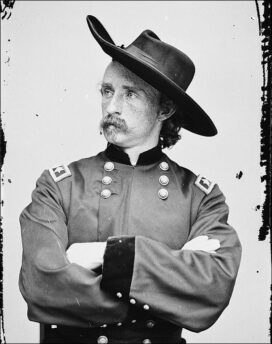
Facts about George Custer
George Armstrong Custer Biography
George Armstrong Custer was on the losing end of a violent clash between Native Americans and the U.S. Army at the Battle of Little Bighorn in 1876. The battle was so famous that it became known as “Custer’s Last Stand.”
George Custer graduated at the bottom of his class at West Point military academy, but saw extensive action as a Union cavalry officer in the Civil War and reached the wartime rank of major general. After the war he was made lieutenant-colonel of the Seventh Cavalry on America’s western frontier.
At Little Bighorn, his troops faced combined bands of Lakota Sioux, Cheyenne, and Arapaho warriors led by the chief Sitting Bull. The battle ended with Custer’s troops encircled on a knoll — thus the name Custer’s Last Stand. Custer and his entire force of over 200 men were killed on the spot.
The battle made George Custer a popular American hero and martyr for nearly a century, but by the late 1900s his star had faded as his tactics were more closely questioned and as popular attitudes toward Native Americans changed. Custer is often now seen more as an ambitious hothead than as a military hero. The site of the battle, in what is now Montana, was designated as a national monument in 1946.
Extra credit
George Armstrong Custer’s body was buried on the battlefield at Little Big Horn, but later exhumed and reburied at West Point… One famous U.S. Army survivor of the Battle of Little Bighorn was the horse Comanche.