

Our biography of the noble horse Comanche has stated for several years that he was the only U.S. Army survivor of the Battle of Little Big Horn — more popularly known as “Custer’s Last Stand.”
But now, having researched the point after a query from friends, we must report that it’s not so. Comanche survived the battle, yes — but he probably, technically, wasn’t the SOLE survivor of Custer’s Last Stand.
Turns out there’s been quite a lot of scholarship, and argument, on the topic of Comanche and his “sole survivor” status. The shaggy old horse is now practically his own subset of Custer studies. Some of the arguments about his status are simple and direct, while others rely on how you define terms like “survivor” or “U.S. Army.”
Some are also a little silly. We can dispense with those who point out that Comanche couldn’t be the sole survivor of Custer’s Last Stand because thousands of Native Americans survived the battle. (Duh: they won. And they weren’t in the U.S. Army.) In a similar vein, we’ll ignore those smarties who point out that U.S. Army soldiers under Captain Benteen and Major Reno also survived the day, since those units were elsewhere during the battle and then rode (too late) to the rescue.
Yes, yes, they were part of Custer’s Seventh Cavalry and they survived. But we’re talking about the last stand, here: the actual hillside battle on June 25, 1876 where Gen. George Custer and his force of about 210 men were entirely wiped out.
With those stipulations, let’s look at the details.
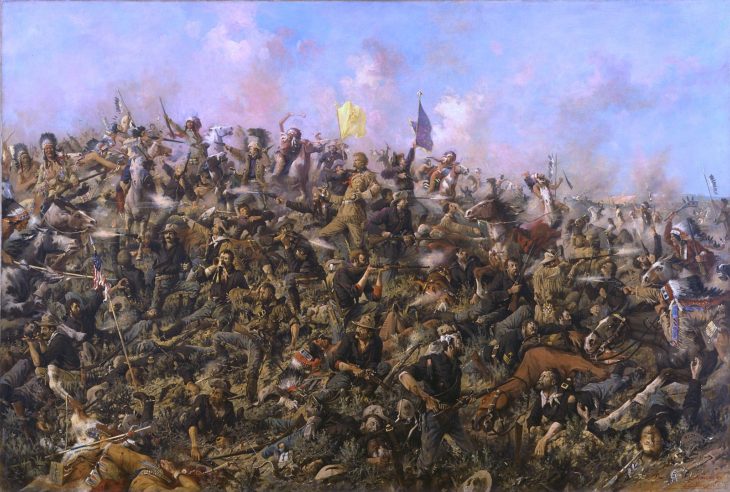
“Custer’s Last Stand” (1899) by Edgar Samuel Paxson, now in the collections of the Whitney Western Art Museum
Everyone seems to agree that several U.S. Army horses survived the actual fighting during Custer’s Last Stand. A few were taken by the Indians or ran wild, and some wounded ones were destroyed on the battlefield by the rest of the Seventh Cavalry when they arrived after the fight was over. In his 1974 book, Peter Thompson’s Narrative of the Little Bighorn Campaign, Daniel O. Magnussen reports:
“There were any number of horses found on or near the battlefield. All horses found alive were wounded so badly that the Indians left them for dead. With the exception of Comanche, all were mercifully shot by the cavalrymen… All usable horses were taken by the Indians and former Seventh Cavalry mounts were noted in various Indian agencies in future years.”
If a grievously wounded horse survived the battle just long enough to be found by soldiers who then shot him out of mercy, you can decide for yourself whether that counts as being a “survivor of Custer’s Last Stand.” Dr. Magnussen and other nitpickers feel it does. We don’t. But: point taken on the horses grabbed by the victorious Indians.
Some writers also claim there were other surviving horses that were then unsaddled by soldiers and turned loose to take their chances on the prairie. (It’s not clear why this would be done with goods as valuable as cavalry horses, but oh well.)
So much for the horses. Next up are the various humans who survived the events surrounding the battle, or claimed to have. The most notable was Curley, a Native American scout riding with General Custer who escaped before the battle took place and tried to alert other Seventh Cavalry soldiers.
A tale grew up that Curley escaped during the battle by covering himself with a Native blanket (drawing it about him “in the manner of the Sioux”) and stealing away. That would technically make him a survivor of the battle itself, yes. But that story seems to be false. Again, some feel that leaving just before the battle started makes Curley a survivor of the Last Stand. We think it makes him someone who barely avoided Custer’s Last Stand.
Human nature being what it is, many bewhiskered old boys popped up in America’s public squares and taverns in the years after the battle, claiming to have survived Custer’s Last Stand. Historians don’t credit them much.
So it’s widely agreed that of the U.S. Army soldiers trapped with Custer at the start of the battle, none survived.
Now back to Comanche: He was wounded but wasn’t captured by native warriors or destroyed by Americans, for reasons unknown. (Evan Connell, in his 1984 Custer biography Son of the Morning Star, recounts the story that Comanche’s master, Miles Keogh, died with the reins still clutched in his hands, “a fact which may have prevented Indians from taking his horse.”) Even the manner of the horse’s discovery is a matter of dispute and confusion: As Connell notes, various soldiers took credit for finding Comanche alive on the battlefield, in a ravine, or in a nearby clump of trees.
Seven wounds is the traditional number that Comanche is said to have received in the fray. Some said more or less at the time (Peter Thompson’s narrative claims five), but seven has been generally accepted as the number.
At least we do know what happened to Comanche after the Last Stand. He was taken care of by soldiers and then shipped back to Kansas, where he died at Fort Riley 15 years later, in 1891. By that point the legend of Comanche as the only survivor of Custer’s Last Stand had become firmly entrenched. Peter Magnusson again:
“[Comanche] became the pet of the regiment as well as the bane of the ladies’ wash lines for he walked through many on his wanderings around the post. He also developed quite a taste for beer at the post canteen where he was treated by the soldiers.”
So there’s a solid grain of truth in the original tale: Comanche does seem to be the one certified soldier or horse from the hillside who made it back to U.S. territory to “tell the tale,” as it were. If only he could talk.
A fine book was written about Comanche in 1989: His Very Silence Speaks: Comanche, The Horse Who Survived Custer’s Last Stand. The author, Elizabeth Lawrence, has a whole chapter on the “sole survivor” topic and concedes that Comanche probably wasn’t the only creature present to make it out alive. By boiling down the various arguments and known facts, and being scrupulously precise about the meanings of all the words, she works it out that Comanche COULD fairly be called this:
“The only equine member of the federal cavalry forces in Custer’s immediate command who was known to have left the battlefield in the hands of the military and whose life can be generally chronicled from that time until his death.”
In other words, the sole survivor. (Oops!) Seriously, Lawrence’s extraordinarily careful description is good enough for us, even if it does drain most of the thrill out of the thing. Lawrence does do her best to bring back the thrills on a higher spiritual level:
“Comanche, an equine survivor, stands as the perfect hero of the times, ‘a horse for all seasons.’ He existed not just physically beyond the tragic battle known as Custer’s Last Stand, but he lived on in legend and lore, and his memory and spirit continue to give symbolic meaning to much that is universal in human experience… Seldom in history have people wished so fervently that an animal could possess the gift of speech, to reveal the first-hand knowledge that was forever locked within the dead of Custer’s Last Stand.”

Good old Comanche! If you happen to be in the Midwest, you can still see him today: His mounted hide is on display at the Natural History Museum of the University of Kansas.
Comanche was not the only horse that survived this battle. A grey horse named Nap, was also found down at the creek. I read that the men, on arrival had a hard time catching the horse. He may have suffered what we call in people as ‘shell shock’ from battle. It may have been the only thing that ‘saved’ him from being taken by the Indians as well. I’ve seen the picture of him standing beside Comanche with an enlisted man holding them both. If you’re a big Comanche fan, I know you’ve seen it.
Thanks for the note, Linda! No, we didn’t know about Nap. I did a little looking online but only find a few passing mentions of him (“also survived,” etc.). Have you got any good leads for more information?
The Grey horse pictured with Capt. Isley and the trooper is actually Capt. Isley’s horse. Their is no known photograph of “Nap” short for Napoleon. Remember Capt. Isley was the troop commander for Co. E. He was on detached service during the battle.
Wait, which pictured horse are you talking about — the one on the card at the start of this post, or a different one?
The picture Linda J. Scott was talking about in her post. It is the first post on here.
Ah, got it, thanks! I can tell we have some devoted Comanche scholars here.