
Facts about Homer Plessy
Homer Plessy Biography
Homer Plessey was the man in the middle of the 1896 Supreme Court ruling that confirmed the rule of “separate but equal” in United States law.
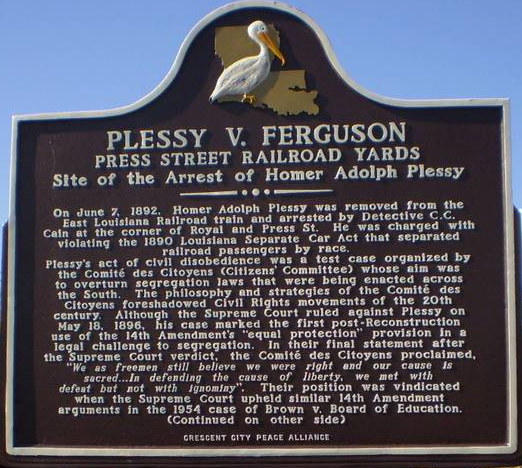
Homer Plessey was a light-skinned Creole of European and African descent. He was arrested and jailed in 1892 for sitting in a Louisiana railroad car designated for white people only. The arrest wasn’t a surprise to Plessy: he had purposely violated an 1890 state law, called the Separate Car law, which required that passengers on Louisiana trains be segregated by race.
Plessy claimed in court that the Separate Car law violated the 13th and 14th amendments to the U.S. Constitution, but Louisiana Judge John Howard Ferguson found him guilty anyhow. By 1896 the case had gone all the way to the U.S. Supreme Court, which upheld the legality of Judge Ferguson’s ruling by an 8-1 majority.
The finding confirmed the doctrine of “separate but equal” — the notion that segregation was legal as long as both blacks and whites had equal facilities. The case helped formalize legal segregation in the United States until it was finally outlawed by the Supreme Court in 1954 in the case of Brown v. Board of Education, in which Chief Justice Earl Warren stated, “Separate educational facilities are inherently unequal.”
Extra credit
Homer Plessy’s arrest was an orchestrated event; he was chosen to be the subject of a legal challenge to the segregation laws because he was of mixed race — light-skinned enough to “pass” as a white, and dark-skinned enough to be arrested for sitting in the white section… A similar Civil Rights figure is Rosa Parks, who was arrested for not giving up her seat to a white man on a Montgomery, Alabama bus in 1955.