
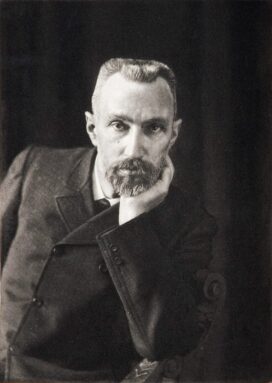
Facts about Pierre Curie
Pierre Curie Biography
Pierre Curie was a 19th century French scientist whose work with his wife, Marie Curie, led to some of the most important discoveries in modern physics and chemistry.
After an unconventional education at home, Pierre Curie attended the Sorbonne in Paris, where he became an assistant teacher in 1878. By 1880 he and his older brother, Jacques, had earned notice for their work demonstrating the electrical potential of quartz crystals when pressure was applied, a phenomenon called piezoelectricity. Pierre took a post at the Paris Municipal School of Industrial Physics and Chemistry and went on to do important work in magnetism, including the discovery that there is a critical temperature at which the magnetic properties of a substance disappear (called the Curie point or Curie temperature).
In 1895 Pierre married Marie Sklodowska, and together they made groundbreaking advances in the knowledge of radioactive elements, including the discovery of polonium and radium. They shared a 1903 Nobel Prize in physics with Henri Becquerel for their painstaking work with radioactive elements, and in 1904 Pierre was given a professorship at the Sorbonne. Pierre Curie died tragically at age 46 in an unusual accident: as he crossed a street on a rainy day in Paris, he was run over by a horse-drawn wagon filled with tons of military uniforms.