
They Thrilled Their Way Into History
Some people make their mark with brains or business savvy. Some use a God-given artistic talent.And then there are those who simply use their hide as a battering ram on the door of fame.Call them daring, persistent, or just plain reckless: we salute these people who are more famous for their guts than for their grey matter.
EVEL KNIEVEL made his name by breaking his own bones — 35 of them, he reported in a 1998 interview. Knievel rose from rugged Butte, Montana to international fame by jumping motorcycles over cars, trucks, foundatins and sharks. Sometimes he landed safely and sometimes he crashed headlong and spectacular-like.
In 1974, Knievel tried to fly a rocket-powered “motorcycle” over the Snake River Canyon in Idaho on national TV. The craft’s parachute opened at takeoff, ruining the attempt, but Knievel drifted to the canyon floor and survived.
Evel Knievel retired after a 1976 crash nearly wiped out several observers along with himself.
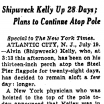
The fad was called flagpole sitting, and ALVIN ‘SHIPWRECK’ KELLY was the acknowledged king.
Kelly claimed to be a former sailor who had honed his talent for heights while rigging sails. He made flagpole sitting into a paying career in the 1920s and 30s, travelling the country and perching atop tall buildings for 50 hours or more as a publicity stunt for local sponsors. Kelly’s longest stretch atop a flagpole was a remarkable 49 days in Atlantic City, New Jersey, in 1930 — a new world record.
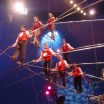
THE FLYING WALLENDAS continue working without a net long after most other circus performers have opted for safety. The Wallenda specialty is wire-walking, which they do in the circus ring, between skyscrapers, and wherever else they seem to feel like it.
The famous Wallenda pyramid involves seven members of the troupe atop each other’s shoulders on three levels — sometimes with a chair on the top level for good measure. A pyramid collapse in 1962 killed two of the family, and the family patriarch, Karl Wallenda, died in a 1978 high wire fall at age 73.
Still, the next generation of the family revived the pyramid in 1998, and a seventh generation of Flying Wallendas continue to perform around the world.

Gastric daredevil TAKERU KOBAYASHI gulped 50 hot dogs in 12 minutes at the annual Nathan’s Famous contest on Coney Island in 2001, doubling the previous record of 25 hot dogs.
Kobayashi’s astounding achievement, which doubled the previous record of 25 hot dogs, was all the more amazing given his height (5’7″) and weight (131 pounds). Kobayashi became an instant celebrity and opened the (refrigerator) door to the eating competition craze of the early 2000s. He even ate 17 pounds of pan-seared cow brains to win $25,000 in a made-for-TV event called the Glutton Bowl.
Takeru Kobayashi won the Nathan’s Famous contest six straight times, from 2001-06, until he was finally unseated by rival Joey Chestnut.
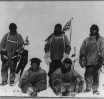
Not to pick on a brave man, but ROBERT FALCON SCOTT may be the all-time example of headstrong futility.
Scott led a party of five across the Antarctic on foot, hoping to be the first man ever to reach the South Pole. He arrived in January of 1912, only to find that Norwegian explorer Roald Amundsen had gotten there a month earlier. (Amundsen took a shorter route and used sled dogs.)
On the march back, Scott and his valiant group all died of cold, hunger and exhaustion. When their final camp was dug out the next summer, the search party found 35 pounds of rock samples which the group had dragged with them all the way from the Pole.
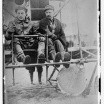
The experts say the first plans for a parachute were drawn up by Leonardo da Vinci in the late 15th century. It wasn’t until the 1800s that people started messing around with silk parachutes, however, jumping off high places or out of hot air balloons just to show off.
And in March of 1912, CAPTAIN ALBERT BERRY of the U.S. Army became the first man to parachute safely from a powered airplane. He jumped from a biplane flown by pilot Tony Jannus about 1500 feet over Jefferson Barracks, near St. Louis, Missouri. Remember that airplanes had been around less than a decade, making the feat that much more impressive.

Known as “The Yankee Leaper,” SAM PATCH was the first person ever to jump over Niagara Falls and survive.
Patch had already made numerous leaps at other sites when he made his famous Niagara Falls jump in October of 1929. His success there whetted his appetite for still more jumps, and on the 13th of November (yes, a Friday) he leapt from the Upper Falls of the Genesee River in Rochester, New York, and disappeared in the swirling waters below. Alas, his body was found downstream four months later.
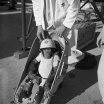
It’s no great insult to say HAM THE CHIMP wasn’t a brainiac. He was a chimp, after all.
Ham was sent into space in 1961 to test the stratosphere for Alan Shepard, the American (human) astronaut who followed later in the year. Shepard got a ticker-tape parade; Ham’s reward was a tasty apple.
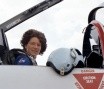
And now for some risk-takers of another type: women daredevils of the sky.