
Physicians Who Gained Fame as Authors
The hand which wields a scalpel is often swift with a pen. Want proof? Here are some certified doctors who became famous writers.
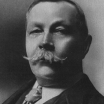
The original and still the champ, SIR ARTHUR CONAN DOYLE created one of literature’s most enduring characters: detective Sherlock Holmes. Doyle earned his medical degree from Edinburgh University in 1881 and began writing while practicing medicine in the town of Southsea. His first Sherlock Holmes novel, A Study in Scarlet, was published in 1887. Doyle introduced the medical arts into his stories in the person of Holmes’s sidekick, the loyal Dr. John Watson, basing that character in part on his own experiences. Even after the huge success of his Sherlock Holmes myteries, Doyle served as a field doctor in the Boer War (1899-1902).
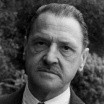
Unlike Sir Arthur Conan Doyle, W. SOMERSET MAUGHAM never really practiced medicine. Maugham attended St. Thomas’s Medical School in London in the 1890s and served as a medical intern in the city’s slums. That led him to write his first novel, Liza of Lambeth, which was a modest success upon its publication in 1897. After his graduation Maugham quickly abandoned medicine and devoted himself to writing. Maugham’s best-known character, Philip Carey in Of Human Bondage (1915), takes the opposite tack: at first an aspiring artist, Carey becomes a country doctor at novel’s end.
(Photo of Somerset Maugham in 1934 by Carl Van Vechten. Part of the Carl Van Vechten collection at the U.S. Library of Congress, Prints & Photographs Division. Digital ID: LC-USZ62-42520 DLC.)
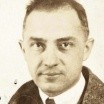
WILLIAM CARLOS WILLIAMS was a doctor all the way. Born in Rutherford, New Jersey, Williams studied in France and Switzerland before getting a medical degree from the University of Pennsylvania. Not long after, he returned to Rutherford and began work as a general practitioner. He continued that work for over 40 years. Somehow he still managed to find time to write essays, novels, and world-class poetry. According to biographer Babette Deutsch, Williams “often expressed resentment at having to practice medicine to pay the way for his writing. But that he enjoyed his practice, which was largely among the poorer working people in and near his native town, is evident in the references to it in his poems and his fiction.” Williams retired from medicine in 1951; in 1963 he won a posthumous Pulitzer Prize for poetry.
(Passport photo of William Carlos Williams in 1921. Photo courtesy of the Beinecke Rare Book & Manuscript Library, Yale University, via Wikimedia Commons.)

ROBIN COOK has been called “the master of the medical thriller.” A graduate of Columbia University medical school (with post-grad work at Harvard thrown in), Cook is one of the few doctor/authors to write especially about medicine; nearly all of his books deal with hot medical issues of the day, from bioterrorism to organ donation to medical patents. Cook’s books are regular bestsellers and many have been made into feature and TV films. His publisher describes him as being “on leave from the Massachusetts Eye and Ear Infirmary.”
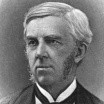
OLIVER WENDELL HOLMES, SR. not only wrote a great deal but helped found the literary magazine Atlantic Monthly. Holmes was a respected Boston doctor and a professor of medicine at Harvard from the 1840s through the 1880s, yet all the while he was also penning essays, stories and poems. His musings for Atlantic were collected as The Autocrat of the Breakfast Table; the book and its sequels were highly popular in their day. Holmes is also known for his patriotic poem “Old Ironsides,” which helped prevent the scrapping of the warship U.S.S. Constitution. His son, Oliver Wendell Holmes, Jr., later became a justice on the U.S. Supreme Court.
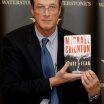
A century after Oliver Wendell Holmes taught at Harvard Medical School, MICHAEL CRICHTON paid his way through the same school by writing fast-and-cheap thrillers under various pseudonyms. Even there he showed remarkable talent: one of his quickies, A Case of Need, won the Edgar Award as best mystery novel of the year. During Crichton’s final year at Harvard his smash hit novel, The Andromeda Strain, was published and quickly sold to Hollywood. Crichton graduated from Harvard Medical School but never practiced medicine. Instead he turned to writing novels about the tensions of modern society, often with a sci-tech bent. Included: The Terminal Man (1971), Sphere (1987), and Rising Sun (1992).
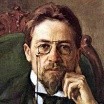
Like Crichton, ANTON CHEKHOV published while still a student. His first collection of stories, The Fairy Tales of Melpomene, appeared in 1884, the same year he graduated from Moscow University Medical School. Unlike Crichton, Chekhov continued to practice medicine and earned a reputation for helping the poor and downtrodden of his native Russia. Chekhov once wrote in a letter to a friend, “Medicine is my lawful wife, and literature is my mistress. When I get fed up with one, I spend the night with the other.”
(Portrait of Anton Pavlovich Chekhov by Osip Braz, 1898. Image via Wikimedia Commons.)
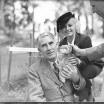
Honorable Mention: ZANE GREY. His early skill at baseball won Zane Grey a scholarship to the University of Pennsylvania, where he earned a degree from the School of Dentistry in 1896. Though Grey actually had his own dental practice in New York for several years, his heart was never quite in the job; he preferred fishing and, especially, writing. A trip to the Grand Canyon opened up new creative territory for Grey, and his first western novel, The Heritage of the Desert, was published in 1910. When his smash hit Riders of the Purple Sage was published in 1912, America had lost a dentist but gained a beloved western author.
(Photo of Zane Grey with Lillian Pertka and a koala (center) during a visit to Australia in 1935. From the State Library of New South Wales, via Wikimedia Commons.)
Interested in unusual writers? Read about Robert Ripley and Leonard da Vinci in…