
Famous Steeds and the Humans Who Rode Them
Certain famous people have passed down through history hand-in-hoof with their beloved horses. Here are seven famous steeds and the humans who rode them to glory.
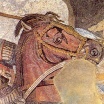
BUCEPHALUS owes his fame mainly to the historian Plutarch, who described the horse in his biography of world-beater ALEXANDER THE GREAT. Plutarch tells the tale of how young Alexander, audacious even as a boy, tamed the wild horse by turning its head into the sun, thereby preventing it from being frightened by its own shadow. That story may or may not be true, but Bucephalus was indeed Alexander’s mount for many of his military campaigns. The horse was eventually killed in battle and given a solemn funeral by Alexander himself.
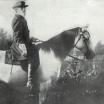
Twenty centuries after Alexander the Great died, General ROBERT E. LEE led the forces of the Confederacy in the American Civil War. Lee’s horse TRAVELLER became a familiar and beloved figure among Confederate troops as he carried Lee on the war’s many long campaign marches.
Lee once described Traveller this way in a letter to his wife’s cousin:
“If I was an artist like you, I would draw a true picture of Traveller; representing his fine proportions, muscular figure, deep chest, short back, strong haunches, flat legs, small head, broad forehead, delicate ears, quick eye, small feet, and black mane and tail. Such a picture would inspire a poet, whose genius could then depict his worth, and describe his endurance of toil, hunger, thirst, heat and cold; and the dangers and suffering through which he has passed.”
After the war, General Lee took Traveller with him into retirement, and the horse was finally buried near Lee’s tomb on the campus of Washington and Lee University.
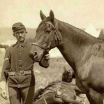
GEORGE CUSTER was also an officer in the Civil War, but his big defeat came later: in 1876 he and all his troops were killed in a battle with Native Americans which became known as Custer’s Last Stand. The most famous non-human survivor of that battle was COMANCHE, an Army horse who came through wounded but alive. (Comanche belonged not to Custer but to one of his officers, Miles Keogh.) Comanche was so famous that after his death in 1891 his hide was mounted and put on display at the University of Kansas, where it remains to this day.
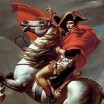
Another famous military pair: NAPOLEON BONAPARTE and MARENGO. Marengo is generally thought to be the horse pictured in Jacques-Louis David’s dashing painting, Napoleon Crossing the Alps. Marengo became more famous after Napoleon’s loss at the Battle of Waterloo: the horse was captured by the British and taken to England. Marengo was displayed by the British both before and after his death (ending up on permanent display much like another famous horse, Trigger).
While Marengo remains famous, it seems clear that he was only one of many horses used by Napoleon during his career, a notion that was explored in-depth in Jill Hamilton’s 2000 book Marengo: the Myth of Napoleon’s Horse.
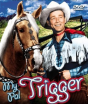
ROY ROGERS and TRIGGER were favorites of the early TV age. Roy Rogers began featuring his handsome wonder horse during his years in the movies, and took Trigger along for the ride when Rogers and his wife Dale Evans began their own successful TV show in the 1950s. (Evans had her own famous horse, named Buttermilk.)
When Trigger died in 1965, Rogers had the horse preserved by a taxidermist, and Trigger spent many years on display in the Roy Rogers -Dale Evans Museum in Victorville, California. The museum later moved to Branson, Missouri and closed for good in 2009. Trigger was then bought at auction for the staggering sum of $266,000 by RFD TV of Omaha, Nebraska. The station said it planned to use Trigger as the centerpiece of a museum.
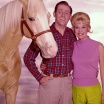
With apologies to Trigger, TV’s most famous horse is probably MISTER ED. The title star of a 1960s sitcom, Ed was a talking horse who brought endless grief to his owner, Wilbur Post. Wilbur wasn’t really “highly effective,” but the part became the signature role for actor ALAN YOUNG. Absurd as the show was, Mister Ed became one of the biggest hits of the 1960s and spawned a well-known theme song beginning “A horse is a horse, of course, of course…”
If you like animals hanging out with humans, you’ll absolutely love our feature on magnificent monkeys.
See some GREAT APES!